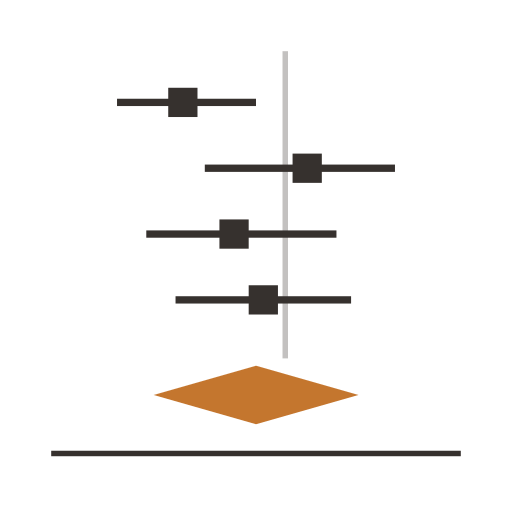
You can import and deduplicate references, screen with a second reviewer, extract data by hand, and run pairwise meta-analysis with GRADE. The free account also includes TITAN title and abstract screening for up to 1,000 references a day. Manual reviews and collaborators are unlimited, and you can export your work at any time.
What the free account includes
Everything you do by hand, plus one model.
$0 · no card
Unlimited reviews, references and collaborators
No project cap, no batch-size cap on manual work, no seat cap for people who screen by hand. Paid plans have no batch-size cap on AI screening either.
Import from any reference manager
RIS, EndNote, PubMed, CSV, Excel and Zotero, with deduplication you can review and merge.
Two-reviewer screening with conflict resolution
Title/abstract and full text, keyboard-first, with the criteria beside the abstract, highlights, labels, notes and undo.
TITAN title/abstract screening on the CPU tier
The TITAN dual3 ensemble scores your records against your eligibility criteria, up to 1,000 references a day.
PRISMA 2020 flow diagram and every export
Decisions, reasons and counts leave the workspace in the formats journals ask for.
Manual extraction and Cochrane RoB 2.0 by hand
Structured forms and the full signalling-question worksheets, without AI drafting.
Pairwise meta-analysis with GRADE
Pooled estimates, forest plots, certainty ratings and Summary of Findings tables.
TITAN screening on the free account
TITAN dual3 on the CPU tier.
dual3-2026-07-12
The same three-member biomedical ensemble that screened every CoreSR review from July to October 2026: one long-context BioClinical ModernBERT-large member and two BioLinkBERT-large members reading the head and the tail of each abstract. It runs on a dedicated CPU service, never on GPU time.
References per day
1,000
Never GPU time
CPU only
Sensitivity settings
6
One run at a time per batch, and 1,000 references a day across your account; the allowance resets at 00:00 UTC. A larger batch screens up to the day’s allowance and pauses; press Resume the next day to continue, or screen it in one go on a paid plan. Expect roughly two seconds per record on the CPU tier, so a full day’s allowance takes about half an hour.
Operating points on the free account
You choose a target sensitivity and TITAN applies the matching calibrated threshold. The specificity column is the dual3 validation-fold specificity at each delivered-recall target; the right-hand column shows what the paid TITAN v6 model reached on 60 held-out reviews at the same target.
Free-account TITAN dual3 operating points with specificity, next to the paid TITAN v6 held-out specificity
Sensitivity target
dual3 specificity (free)
v6 specificity (paid)
99.5% · Max recall
59%
78%
99.0% · High recall
66%
85%
97% · 0.97 sens
76%
95%
96% · 0.96 sens
78%
95%
95% · Balanced
79%
96%
93% · Spec-leaning
83%
96%
Specificity is the share of records that are not eligible and are screened out, so your team reads fewer of them. At the default max-recall setting the free model removes roughly six in ten records; the paid v6 model removes close to eight in ten and was trained on the study’s final inclusion rather than the title/abstract decision.
Plain rules
A batch keeps the model that first scored it, so its scores and thresholds always line up. If you upgrade mid-review, new batches use TITAN v6 on GPU; an existing dual3 batch can be finished as is, or screened again from scratch with v6. The free account screens with the TITAN engine only: GLASS full-text screening, extraction, risk-of-bias passes and search stay with paid plans. Nothing you screen on the free account counts against an AI quota.
When you need more
What paid plans add.
7-day trial
TITAN v6 on GPU
The October 2026 model, trained to predict final inclusion, on the workstation GPU: faster, and 78% of records screened out at the max-recall setting on held-out reviews.
GLASS full-text screening
Grounded worksheet decisions with verbatim evidence quotes, one or two AI reviewers.
AI extraction and risk of bias
PDF data extraction and signalling-question passes on the core instruments.
Database search and drafting
EviTrace search strategies across licensed databases, and manuscript drafting.